


Table of Content
AI Overview
-
AI enhances content creation, SEO, personalization, social media management, and marketing analytics by automating repetitive tasks and generating actionable insights.
-
Popular AI tools such as Jasper AI, Surfer SEO, Lexica Art, Notion AI, and Originality AI help marketers scale content, optimize search visibility, and improve productivity.
-
AI enables hyper-personalized marketing by analyzing user behavior, demographics, and preferences in real time.
-
In paid advertising and PPC, AI optimizes bidding strategies and audience targeting to maximize ROI.
-
AI-driven analytics uncover hidden patterns and predict customer behavior, supporting smarter, data-driven decisions.
-
Key benefits include increased efficiency, scalable high-quality content, predictive insights, and improved customer engagement.
-
Challenges include implementation costs, lack of transparency in AI decisions, and ethical concerns around data privacy and bias—making human oversight essential.
-
The future of AI in digital marketing lies in predictive personalization, automated workflows, smarter ad targeting, and AI-powered chatbots delivering seamless customer experiences.
What is AI Digital Marketing?
AI in digital marketing refers to the use of artificial intelligence techniques to automate tasks, analyze data, and gain customer insights to improve marketing efforts. To simplify, it is leveraging AI's power to make your digital marketing smarter and more effective.
The AI Role in Digital Marketing:

The role AI plays in the digital marketing realm is important for enhancing several aspects of it. Following are some key areas where AI has made a significant impact:
- Content Creation: AI tools such as Grammarly can review your content and make suggestions about grammatical errors as well as style and tone. They can also help with coming up with ideas for content and tailoring it to suit particular audiences.
- Personalization & Targeting: AI can analyze customer information and group them accordingly. Facebook Ads show products based on what a person has been looking for. This promises a personalized and effective experience for every user.
- Search Engine Optimization (SEO): Tools like Surfer SEO can use their algorithms to determine keywords that your competitors rank for and the type of content that works well with search engines. This allows you to improve your website’s search ranking by optimizing its content accordingly.
- Social Media Marketing: It can be tedious to manage social media platforms manually. AI platforms such as Sprout Social help in scheduling posts, finding relevant posts for sharing and even understanding brand sentiment by analyzing online conversations, thus, effectively managing your social presence.
- Marketing Analytics & Reporting: With AI, data analysis is no longer a manual affair. Marketing behemoths like Google Analytics employ AI to identify patterns in customer behaviour and predict future trends. This enables you to tweak marketing campaigns for better results, therefore increasing ROI and generally becoming more objective in decision-making based on data.
What Are the Best Digital Marketing Tools for Marketers?
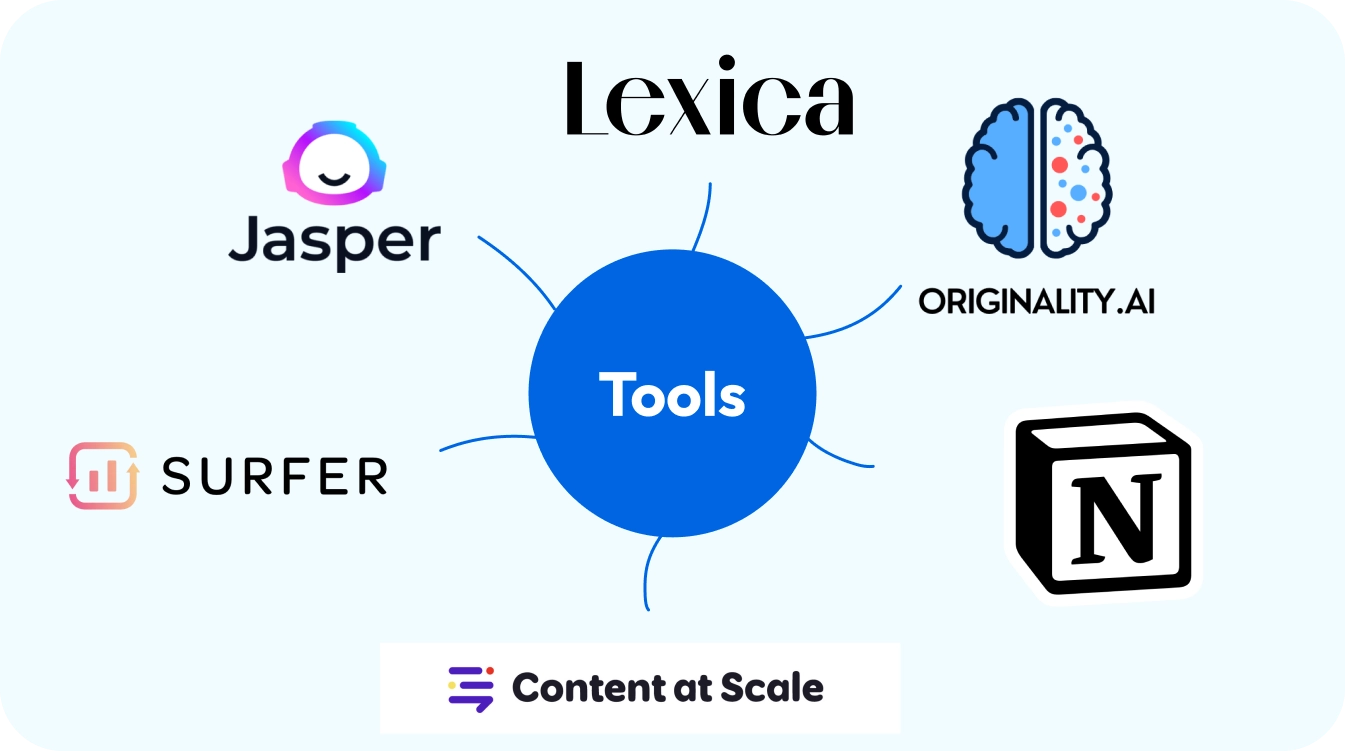
Using the right digital marketing tools can significantly enhance your marketing efforts. Here are some of the top tools:
- Jasper AI: AI copywriting tool for content creation across email campaigns, social media, websites, and marketing.
- Surfer SEO: AI-driven SEO solution offering data content optimization for better visibility and traffic.
- Lexica Art: AI graphic design tool for creating great visuals, infographics and social media posts.
- Notion AI: AI productivity tool for digital marketers which integrates with your calendar and email to prioritize tasks.
- Originality AI: AI solution for detecting plagiarism and improving content originality. Content at Scale: AI solution for optimizing your marketing content efficiently.
Uses of AI in digital marketing
AI is used in digital marketing to enhance efficiency, accuracy, and effectiveness across various aspects of marketing strategies and campaigns.
1. Content and Image Creation:
- Content Generation: AI tools can craft blogs, product descriptions or even social media captions; specifically for the brand's voice and target market.
- SEO: AI will analyze search trends and competitor content to recommend the best keywords for your search rankings and drive more traffic.
- Attractive Visuals Made Simple: AI can create high-quality images and videos tailored towards specific demographics. It also speeds up creativity while ensuring that the produced visuals resonate with the respective audience.
2. Customer Service and Support:
24/7 Personalized Assistance: Instant customer care is provided by AI chatbots which answer common questions while personalizing interactions based on a client’s history. This leaves human representatives with time to handle complex inquiries and offer clients a smooth experience throughout.
3. Pay Per Click (PPC):
Smarter Bids Strategy: It identifies the most relevant audiences through analyzing large data volumes thereby adjusting bids in real-time for maximum return on investment.
4. Data Analysis:
Discovering Hidden Insights: By processing huge datasets, AI can draw out invaluable customer information and predict future behaviour. This enables personalized marketing campaigns to anticipate the client’s needs and optimize the entire marketing strategy towards better results.
Benefits of using AI in digital marketing:
AI has numerous advantages in digital marketing that can greatly help businesses. Here are some of the top pros of AI in digital marketing:
- Increased efficiency and automation: AI automates tasks to save time and resources while also improving productivity.
- Enhanced personalization and customer targeting: AI analyzes data for providing personalized content and targeted marketing which leads to higher customer engagement.
- Improved Data-Driven Decision-Making: Enhanced data-driven decision-making is done by analyzing a large volume of information to deliver actionable insights that allow for more informed strategic decisions.
- Valuable insights and predictive analytics: AI offers valuable insights and predictive analytics that enable informed strategic decision-making.
- Creation of high-quality scalable content: AI-generated high-quality original content at scale to meet diverse audience needs.
Challenges and considerations:
1. Cost of implementation and ongoing maintenance
- Initial investment: Small and medium-sized businesses may find it difficult to implement AI solutions due to the cost involved in hardware and software purchase
2. Lack of Transparency and Explainability in decisions:
- Black Box Problem: Most algorithms in artificial intelligence are complex and non-transparent which makes it hard to comprehend how they came up with certain decisions.
- Necessary Human Involvement: There should be oversight by humans in charge of AI-powered marketing tools. For a marketing campaign’s success, marketers must know why the software made its recommendations besides understanding any potential biases built into them or ethical issues surrounding these decisions.
3. Ethical Considerations about Bias and Data Privacy:
- Fear of Leaking Data: Artificial intelligence marketing is dependent on extensive data collection and analysis. Therefore, marketers must ensure proper compliance with privacy laws when collecting user information so as not to violate anyone’s rights.
- Biased Information: To a greater extent, the datasets used for training AI are always prone to some level of bias. Lack of supervision can lead to discriminatory practices in marketing.
The Future of Artificial Intelligence:
AI is rapidly transforming the digital marketing world, offering a number of benefits for reaching and engaging customers. Here's how:
- Personalization: AI reviews enormous quantities of customer data such as demographics, browsing behavior, and prior interactions. This permits marketers to adjust content, messaging, and product suggestions immediately so that each individual feels like they’re having a unique experience.
- Automated Marketing Workflows: AI may be used for automating repetitive jobs including data analysis, campaign management, or even email scheduling among others thus allowing more time for creativity in marketing strategy development efforts.
- Smarter Ad Targeting: By analyzing user behavior patterns through engagement metrics alongside conversion information using machine learning algorithms; insights gained could be employed to identify where, when and whom should different adverts be displayed, hence making them more effective at achieving desired results while enhancing return on investment (ROI).
- Predictive Customer Behavior: Instead of relying solely on historical actions taken by clients as a basis for personalization; artificial intelligence goes further to predict what future actions are likely going to be taken not only for new but also existing buyers so that very specific marketing campaigns can be developed.
- Chatbots & Virtual Assistants: These days chatbots created by AI are used to offer support services round the clock such as answering FAQs or even qualifying leads thereby improving customer experience besides releasing human agents for more challenging inquiries.
Conclusion:
In conclusion, AI changes the face of digital marketing, bringing along many benefits to businesses. From data-analyzed content to experiencing personalization and predictive customer behavior, AI, undoubtedly, enables the marketer to work smarter and not harder.
And as AI progresses, without a doubt, it will redefine the world of digital marketing, undoubtedly a total future for customer experiences: seamless, personalized, and driven by intelligent automation. By embracing AI in digital marketing, the increase in efficiency and productivity is further expanded so as to unleash new insights and opportunities for growth in the increasingly competitive market.
To understand more about the growth of and importance of digital marketing you can refer to this page.